
My visit to Tokyo, Japan, in April 2016, remains one of the most memorable experiences of my life. Even after more than a decade, many things that I saw and experienced there are still quite fresh in my reminiscence.
2. It is difficult to match the Japanese when it comes to punctuality, cleanliness, hard work and sincerity. What overwhelmed me most was not just their technological advancement or the beauty of the country, but the way they conduct themselves in day to day life. There is a sense of discipline and consideration for others which one cannot help but admire.
3. Europe has many beautiful & lovely places to visit, and there is no doubt that it offers a wonderful travel experience. But I feel that Japan has something different to offer. One can enjoy the natural beauty of Europe, but a visit to Japan also gives us an opportunity to learn many things. I would personally recommend a trip to Japan, particularly to those who wish to experience their punctuality and discipline by their own eyes and come back with something more than photographs and memories.
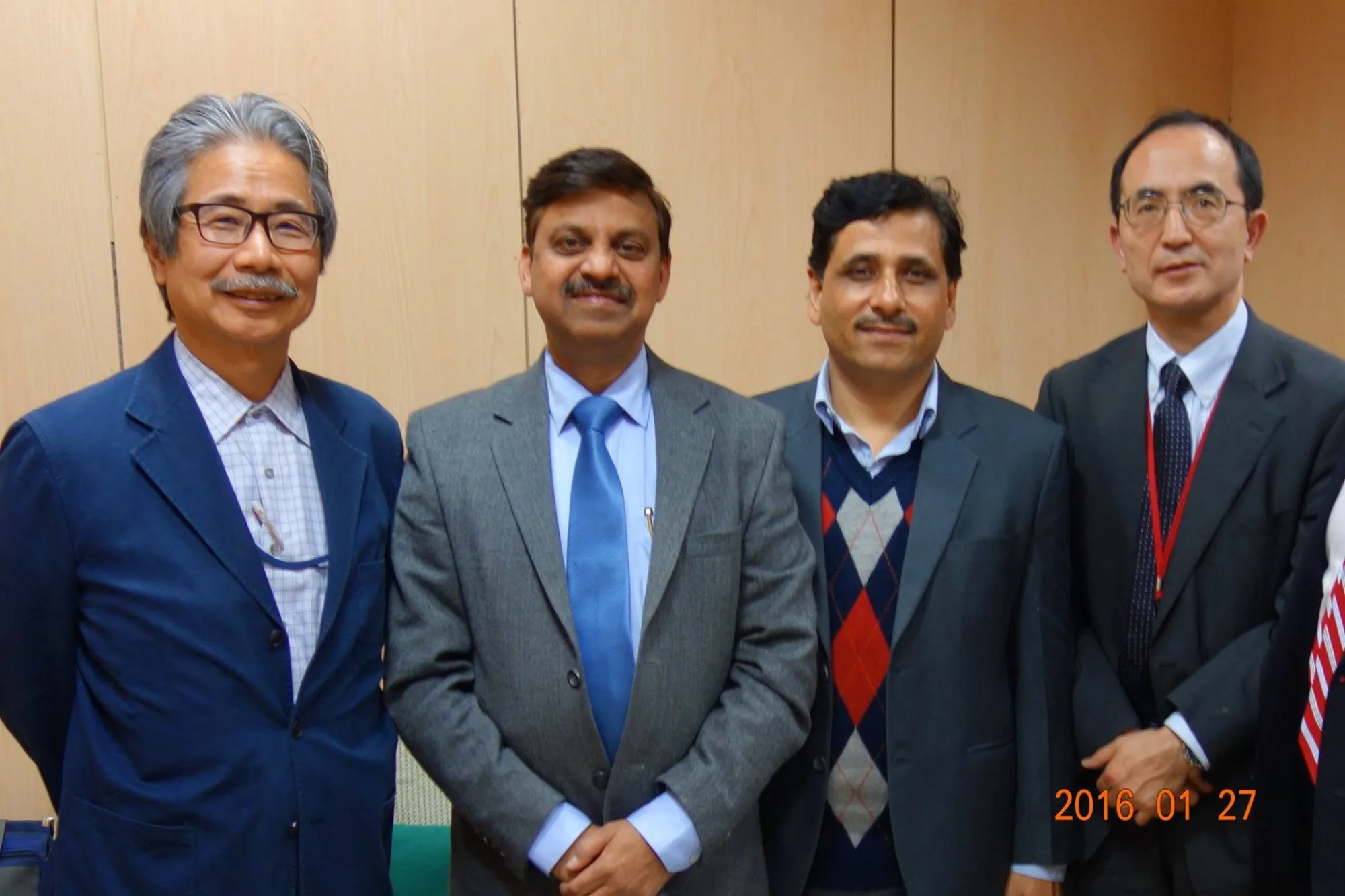
4. One of the highlights of my visit was the opportunity to meet two Nobel laureates. What struck me was their simplicity and humility, despite their incredible and extraordinary achievements which made the life of mankind easier. It is difficult to describe this feeling in words. We often associate great achievements with a certain degree of grandeur, but meeting such accomplished people made me realise that greatness and simplicity can go hand in hand.
5. Meeting Professor Hideki Shirakawa, Nobel Laureate
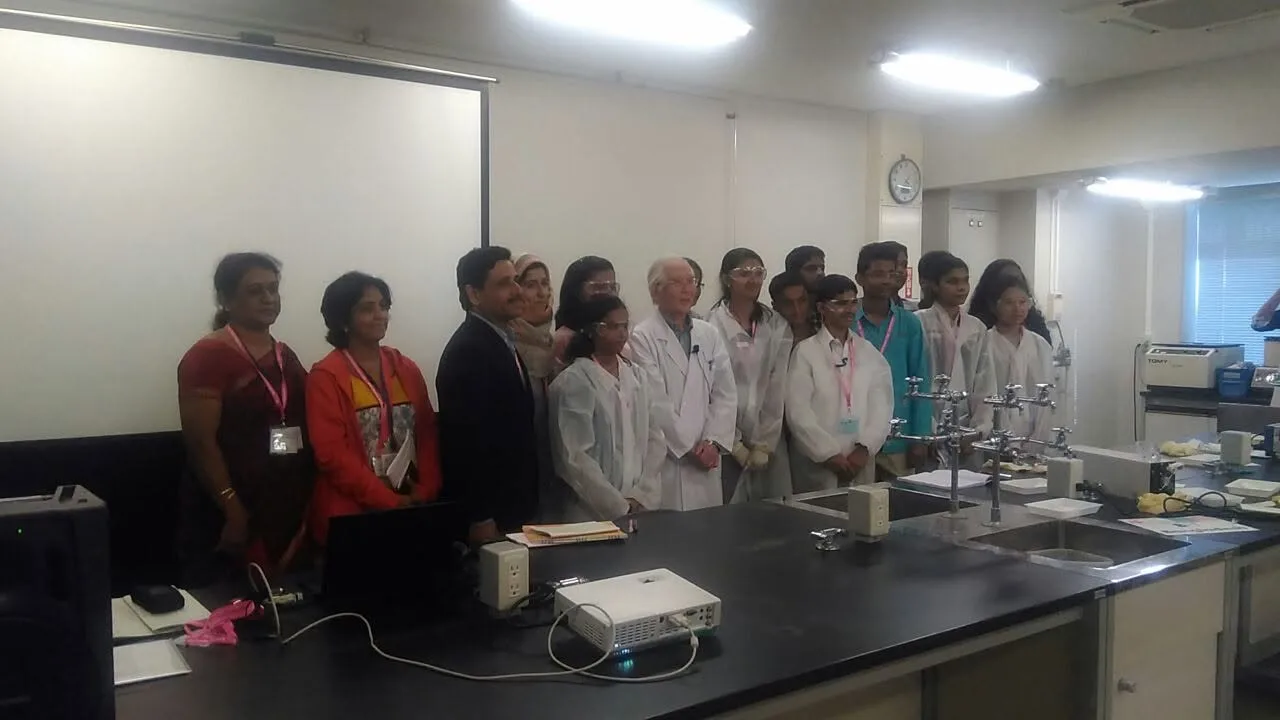
On 19 April 2016, I had the privilege of meeting Professor Hideki Shirakawa, who was awarded the Nobel Prize in Chemistry in 2000 for the discovery and development of conductive polymers.
It was a fascinating experience to see a live experiment related to the very scientific work for which he had received the Nobel Prize. Reading about a discovery in a book is one thing, but watching an experiment and understanding its practical aspects is quite another.
Meeting a Nobel laureate was, of course, a privilege in itself. But what impressed me equally was his simplicity and humility. Despite having made such a significant contribution to science, he came across as a very humble person.
It was a reminder that achievement does not necessarily make a person self-important. In fact, the more one achieves, the more one can learn from those who remain simple and grounded.
6. Some Experiences That have lasting impact:
There were many things during my visit that impressed me, but a few incidents have stayed with me more than others. Even after ten years, I can recall them almost as if they happened recently.
Interestingly, none of these incidents was extraordinary in itself. They were ordinary happenings, but the way Japanese people responded to them taught me treasured lessons.
Road Repair:
One morning, when I was leaving for the day's programme, it was informed that a section of the road near the JICA Centre had been dug up because of a leakage in a water-supply pipeline. The Japanese coordinator advised me to take another route, which was about a kilometre longer.
When I returned in the evening, I was surprised to see that the road had been repaired so neatly that it was difficult to make out that it had been dug up earlier in the day. It looked like a normal, well carpeted road.
I was really impressed by the efficiency with which the work had been completed. At the same time, I could not help wondering why we cannot achieve the same thing in our cities; in spite of interventions of the Central Government through its flagship schemes and missions, such as JnNURM and AMRUT.
In India, we often see roads being dug up for one civic work or another. The work may be completed, but the damaged portion remains in poor condition for months, sometimes even years. And just when a road is repaired, it may be dug up again for another utility work.
As a result, the pathetic condition of the road keeps reminding us of the inefficiency of our civic systems.
The experience in Japan made me realise that completing the main job is not enough. The place should also be restored to its original condition. If a road has been dug up for repairing a pipeline, the work should not be considered complete until the road has been properly repaired.
It may sound like a small thing, but such attention to detail makes a big difference to the quality of public life.
B. Respecting Others: even the volume of our conversation matters
Another incident is equally fresh in my memory.
One day, while we were passing through a residential area, we were discussing the day's events among ourselves. We were talking in a normal voice, at least by Indian standards.
Suddenly, our Japanese coordinator came running towards us and advised us to speak softly, explaining that we were in a residential area and might disturb the residents.
I was somewhat surprised by his reaction. We were not quarrelling or shouting; we were simply having a conversation. But for him, even this was something that needed attention because it could inconvenience their residents.
This incident made me think about how differently we look at such things in India.
Nowadays, the use of loudspeakers in the name of religion is quite common, whether in cities or villages. In our enthusiasm to express our devotion or please God, we often forget that the noise may disturb other people. Unfortunately, the inconvenience caused to others does not always seem to bother us.
I sometimes wonder whether we give enough thought to the people around us while doing things that we consider important for ourselves.
The Japanese coordinator's reaction taught me a simple lesson: respecting others also means being mindful of the inconvenience we may cause them, even when we do not intend to do so.
Perhaps this is one of the things we need to learn most, not just to follow rules, but to think about others before doing something.
C. Punctuality: A Lesson that all must learn:
This was another interesting experience.
Our vehicle was scheduled to leave the hotel at 9:00 a.m. I reached the vehicle before time and boarded it. Another senior officer was also supposed to travel with us.
As the clock approached 9:00 a.m., I watched the seconds tick away. At exactly 9:00 a.m., the driver closed the door and started the vehicle.
I could see the other officer coming out of the hotel lobby at a leisurely pace. But the vehicle did not wait for him. It left as scheduled, and the officer had to arrange his own transport.
For someone accustomed to the Indian way of looking at time, this was quite an experience.
We often take a few minutes' delay very casually. We assume that others will wait for us and that a little adjustment here and there does not matter much. In the process, we forget that our delay may affect the schedules of several other people.
This experience confirmed my belief that time is treated as a commitment. If a vehicle is scheduled to leave at 9:00 a.m., it leaves at 9:00 a.m. One is expected to be ready before that time, not to arrive at the scheduled time and then expect everyone else to wait. Tiny habits from our childhood days makes us respect the value of even seconds.
D. Commitment to duty:
On another occasion, I suggested to our Japanese coordinator that he could leave early after dropping me at the hotel, if he wished to do so.
I thought it was a perfectly reasonable suggestion. After all, once I had reached the hotel, he could have used the remaining time for himself.
But he seemed quite uncomfortable with the suggestion.
His practice was to leave at the designated time, after ensuring that we had been properly settled at our place of stay. He did not appear to consider this an unnecessary formality. For him, it was part of the responsibility entrusted to him.
I found this quite impressive. He was not doing anything extraordinary, nor was he expecting any appreciation for it. He was simply doing his job in the manner he thought it should be done.
This incident made me reflect on our own approach to work. We sometimes tend to look at our responsibilities in terms of the minimum that needs to be done. Once the immediate task is over, we feel that we have fulfilled our obligation.
But there is a difference between merely completing a task and ensuring that the responsibility has been properly discharged.
The coordinator's conduct left me with a simple thought: sincerity towards one's duty is reflected in what one does, not in what one says about it.
7. Japan: more than just a tourist destination
With hindsight, what I remember most about Japan is not any particular tourist attraction or only technological marvel. It is these small incidents that have remained with me over the years.
The road that was repaired within a day, the coordinator who asked us to speak softly in a residential area, the vehicle that left at precisely 9:00 a.m., and the person who did not wish to leave before completing his responsibility. All these experiences taught me something in their own way.
They also made me think about why some societies are able to maintain higher standards of public life. We often talk about economic growth, modern infrastructure, technology and government policies when discussing the development of a country. All these are important. But I feel that the everyday behaviour of people is equally important. Such small traits of citizens add up to the growth of nation.
How seriously do we take our responsibilities and duties? How much do we respect other people's time? How conscious are we of the inconvenience we may cause others? And do we do our work properly even when nobody is watching us?
These may appear to be simple questions, but they have a great deal to do with the way a society functions.
Rules and regulations are necessary, but they cannot solve every problem. Much depends on the habits and attitudes that people develop over time. When discipline becomes a part of everyday life, and consideration for others comes naturally, the entire system begins to work better.
That is what I found particularly impressive about Japan.
8. Final reflection:
It has been more than a decade since my visit, but these experiences have not faded away from my remembrances. Possibly, the reason is that they were not merely things I saw; they made me reflect on my own surroundings and the way we do things back home.
I often wonder how much better our cities and public institutions could function if we adop some of these simple practices and inculcate in our day to day life.
We do not necessarily need to imitate everything that another country does. Every society has its own circumstances and challenges. But there is no harm in learning from those who have managed to do certain things better than us.
For me, the biggest lesson from Japan was that the difference between a well functioning society and a poorly functioning one is not always about resources or technology. Sometimes, it is about how sincerely people perform their duties and how much consideration they show for others.
A properly repaired road, a quiet residential neighbourhood, a vehicle leaving on time, or an employee who remains committed to his responsibility may not appear to be matters of great importance. But when such things become a part of everyday life, they make a significant difference.
My visit to Japan was, therefore, much more than a holiday or an official tour. It was an experience that gave me an opportunity to observe, learn and reflect.
A good journey is one from which we return with pleasant memories. A truly meaningful journey is one that also leaves us with something to think about and something to learn.
For me, Japan was one such journey. Even after ten years, its lessons remain as relevant and as fresh as ever.
Written in a way that expresses the way one should think about the places and the people.Actually the people of a country are the actual assets for the country and Japanes are the best example of it.
Thanks Anjali ji.
Very well articulated writing. Pradeep has put in words his observations in a nice way.
The spirit of community living at macro level is universal amongst the population of Japan. Be it due to upbringing or value system ingrained in the people from a very young age. At individual level or micro level they execute it with a smile.
There are many more behaviours / attitudes of Japanese people worth emulating in our society.